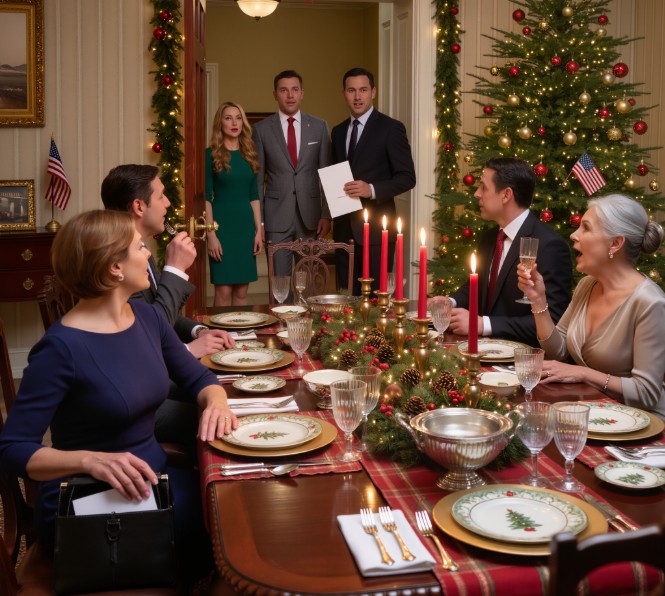
I hope you can forgive us someday.
“I’ve already forgiven you, David. But forgiving doesn’t mean forgetting. It means learning.”
“I understand.”
We shook hands, and in that simple gesture, I felt something close. Not with a cheerful bow, but with dignity.
We spent the day packing. The apartment was indeed small, nothing compared to the house. The living room and dining room were one large space. The bedrooms barely fit a bed and a wardrobe. The kitchen was cramped. But it was clean. And it was theirs—without debts they couldn’t pay, without feeling obligated to anyone.
“What are you going to do with the furniture that doesn’t fit?” I asked.
“We’re going to sell it,” said Sarah. “The large dining table, a few bookshelves, the whole living room set. We’ve already put everything online.”
“And the table?”
Sarah looked at me.
“The table you gave us?”
« Yes. The one there. »
“We’re going to sell it, Mom. It doesn’t fit here.”
I felt a pang in my chest: that table where I had imagined family dinners, laughter, and Christmas.
“It’s okay,” I said. “It was yours. You can do whatever you want with it.”
But Sarah saw my expression.
“Mom, if you want it…”
“No, my dear. I don’t have room for it either.”
And it was true. That table belonged to a dream that no longer existed.
That afternoon, while we were resting, Mrs. Carol arrived. No one had called her. No one had told her we were coming. She simply showed up in high heels, a designer bag, and dark glasses, as if she were going to a social event.
“David, my son, I just came to see how you are doing.”
David emerged from the apartment. When he saw her, his expression hardened.
“Mom, what are you doing here?”
“I came to help with the move.”
We don’t need any help.
David, don’t be ridiculous. Of course you need help. This is…
She looked at the building with disdain.
“This is very different from what you had.”
“It’s what we can afford, Mom.”
“But you didn’t have to come here. If only you had…”
“If only I had, Mom? If only I had forced Mrs. Miller to give us back a house that wasn’t ours?”
“Don’t say nonsense.”
“It’s not nonsense. You never wanted to accept that that house wasn’t ours. And you gave us ideas. You made us believe we were entitled to something that wasn’t ours.”
Mrs. Carol took off her glasses.
“Are you blaming me for this?”
“I’m not blaming you. I’m just telling you the truth, Mom.”
“I only wanted the best for you.”
No, Mom. You wanted the best for your image. You wanted to show off that your son lived in a big house. You wanted to have everything under control. You wanted Sarah and me to live according to your standards.
That’s not true.
“Yes, that’s right. And that’s why we ultimately lost everything.”
Mrs. Carol looked around, searching for support. Her gaze met mine. I stood by the apartment door, observing the scene.
“You,” she said, pointing her finger at me. “You’re behind this.”
“No, Mrs. Carol. I’m just here to help my daughter.”
“You plant ideas in their heads.”
“I didn’t impose anything on them. They made their own decisions.”
You manipulate them.
David stepped forward.
“Stop it, Mom. That’s enough.”
David’s screams echoed through the street. Several neighbors came to their windows. Mrs. Carol turned pale.
“David, don’t raise your voice against me.”
“Then don’t provoke me. Mrs. Miller is my wife’s mother, and from now on you will treat her with respect. If you can’t, you’re not welcome in our lives.”
The silence that followed was horrific. Mrs. Carol looked at her son as if she didn’t recognize him.
Are you going to kick me out?
“I ask you to respect my family. You are my family, and so is Sarah, and so is Mrs. Miller. And if you cannot accept that, then I ask you to leave.”
Mrs. Carol took a step back, her eyes welling with tears. But they weren’t tears of sadness. They were tears of anger.
“You will regret this one day.”
Maybe. But not today.
She turned around. She walked quickly to her car. She got in and left—without saying goodbye, without looking back.
David stood panting in the street. Sarah came out and hugged him.
“I’m proud of you,” she whispered.
He hugged her tightly. And he cried. He cried like I’d never seen him cry before—because he’d just crossed a line he’d been avoiding for 30 years.
And that hurts, even though it’s the right thing to do.
That evening, after the move, we ate pizza on the floor of the new apartment. There was no table yet. There were no chairs. But we were together.
“Mom, thank you for coming,” Sarah said, leaning on my shoulder.
“I’ll always be there for you, my love. But now… with healthy boundaries.”
She smiled.
“With healthy boundaries.”
David raised his can of soda.
“On the way to a new beginning.”
We clinked our soda cans.
“On the way to a new beginning.”
And in that moment, in that small apartment, sitting on the floor, I felt more like family than I had in months in that big house. Because family isn’t measured in square footage. It’s measured in respect, in presence, in true love.
In the weeks that followed, I heard from Sarah that Mrs. Carol hadn’t called David anymore, that she had completely withdrawn, offended, her pride wounded, waiting for his apology. But David offered no apology. And little by little, Mrs. Carol began to feel the burden of her own decision.
In February Susan called me.
“Ellie, I have to tell you something.”
What happened?
“I met Ms. Carol at the grocery store, and she is different.”
“Why different?”
She’s alone, Ellie. Very alone. Her husband works all day. David doesn’t talk to her. And she… she looks sad, old, as if all her pride is collapsing.
I felt no joy when I heard that, nor pity. I felt only understanding.
“She chose pride over love, Susan.”
“I know. And now she’s paying the price.”
“We all pay the price for our decisions.”
Don’t you feel… I don’t know. Some kind of satisfaction?
“No. I just feel at peace.”
Because it was true. I hadn’t done this out of revenge. I had done it to save myself. And the fact that Mrs. Carol had to face the consequences of her own actions—that wasn’t my responsibility. That was karma. That silent justice that comes when you least expect it.
In March, Sarah told me that Mrs. Carol had tried to contact him again. She sent David a message, saying she missed him and wanted to make peace.
“And what did David answer?” I asked.
He told her he missed her too, but that things had to change. That if she wanted to be in our lives, she had to respect our entire family, including you.
“And what did she say?”
She got angry again. She said David asked her to humiliate herself, and she hung up.
I shook my head.
“She doesn’t understand that showing respect isn’t the same as humiliating yourself.”
“No, Mom. She doesn’t understand.”
“Maybe that will happen someday. Do you think so?”
“Maybe when she’s lonelier—when she understands that pride is a very bad companion in old age.”
And so it happened.
Months later, in June, Susan told me that Mrs. Carol had gone to therapy, that she had had an anxiety attack that landed her in the hospital, that the doctor had told her that her blood pressure was very high, that she needed to manage her stress, and that finally, during one of those therapy sessions, she had begun to see her own pattern: her need for control, her fear of being irrelevant, her way of manipulating through guilt.
“And did she look up David?” I asked.
“Yes. Two weeks ago she invited him to lunch and apologized.”
” Real? ”
“Yes, Ellie. She told him she’d been a bad mother, that she’d overloaded him with her expectations, that she regretted trying to control his marriage.”
“In David?”
He cried, Ellie. He cried because he finally heard the words he’d needed for years.
I was silent and processed it.
“And you?” asked Susan. “How do you feel now that you know that?”
“I feel… calm.”
Don’t you think you deserve an apology too?
Maybe someday. Maybe not. But I don’t need it anymore to live in peace.
Because it was true—life had made things fall into place. Mrs. Carol had lost her relationship with her son, lost the control she so desperately needed, faced her loneliness, and finally understood—not through my intervention, but through the natural consequences of her own actions.
That’s karma. It’s not revenge. It’s balance. Life teaches you, with infinite patience, that you reap what you sow. And I—I didn’t need to see her suffer to feel good. I just needed to know that justice had finally been served.
Silent, inevitable, perfect.
Two years have passed since that Christmas Eve. Two years ago, I made the hardest decision of my life. And today, sitting in my small apartment with a cup of coffee in my hands and the morning sun streaming through my window, I can say it was the best decision ever. Not because it was easy, but because it was necessary.
My relationship with Sarah is different now. It’s no longer that mother-daughter relationship where I gave everything and she took without a second thought. Now it’s a relationship between two mature women who respect each other, care for each other, and choose each other.
We see each other every week—sometimes for lunch, sometimes just for a walk in the park. We talk about everything: her work, her marriage, my projects. Because yes, now I have projects.
After selling the house, I had enough money left to not have to worry for a while, so I decided to do something I’d always wanted to do but never dared. I took painting lessons—something I’d been fascinated by since childhood, but which I’d stopped because it wasn’t practical, because I had to work, because I had to be responsible, because I had to sacrifice myself for others.
But now, now I’m painting. I’m no Frida Kahlo, and I don’t pretend to be. But every time I put brush to canvas, I feel alive. I feel whole. I feel myself.
I also joined a group of women my age. We meet every Thursday at a café downtown. We talk about our lives, our children, our pain, our victories. And there I discovered that my story wasn’t unique. That many women had gone through the same thing. Mothers who had faded away in their attempts to please. Mothers who had lost their identity along the way. Mothers who had had to make painful decisions to save themselves.
And in those conversations, I found sisterhood. I found understanding. I found a space where my pain wasn’t dramatized, where my decision wasn’t cruel, where my story held true.
One afternoon one of those women told me:
“Ellie, you are very brave.”
I shook my head.
“I’m not brave. I was just tired.”
“It’s the same thing,” she replied. “Courage isn’t being fearless. It’s being exhausted and taking the step anyway.”
Those words stuck with me. Because she was right. I wasn’t brave because I wasn’t afraid. I was brave because, despite the fear of losing my daughter, I chose not to lose myself.
David and Sarah adjusted to their new life. The small apartment became their home. Little by little, they carefully decorated it—with simple furniture, plants, and pictures. And although it was difficult at first, Sarah now tells me it’s the place where she’s happiest.
“Because it’s ours, Mom,” she said to me one day. “We don’t owe anyone anything. We don’t have to impress anyone. It’s just David and me.”
And that—that was something they wouldn’t have learned if I’d given them everything. Sometimes the greatest love is letting them fall so they can learn to get up on their own.
David and his mother finally found a balance. It wasn’t quick. It wasn’t easy. But after months of therapy, Mrs. Carol began to change. Not completely—people don’t change overnight—but she learned to let go. She learned to show respect. She learned that love isn’t shown with control, but with freedom.
Six months ago, David invited me to lunch, just him and me. We went to a quiet restaurant, and there, while sharing pulled pork sliders, he told me something I’ll never forget.
“Ms. Miller, I know what happened was very painful for everyone. But I have to tell you something.”
“What’s that, David?”
“You saved me.”
I looked at him confused.
” How? ”
You saved me from becoming my mother. When you sold that house, I was furious. I felt like everything had been taken from me. But over time, I understood something. I understood that I was living the life my mother wanted for me, not the life I wanted. And if you hadn’t done what you did, I would have continued like this, trapped, without realizing it.
His voice broke.
“Now I have a simple life. But it’s my life. And that—that’s priceless.”
I took his hand.
“David, I’m so glad you said that.”
Thank you, Mrs. Miller. For everything. Even the pain.
That day I cried in my car on the way home. But not out of sadness, but out of gratitude. Because finally, finally, we had all learned.
Mrs. Carol and I have never been friends. We probably never will be. But we’ve reached an unspoken understanding—a cold but genuine respect. We see each other at birthdays, at family gatherings. We greet each other politely. She no longer sees me as a threat. I no longer see her as an enemy. We simply live side by side.
And that is enough.
Three months ago, I got news from Sarah. One Sunday morning, she showed up at my house with a bag of donuts and a nervous smile.
“Mom, I have to tell you something.”
“What’s the matter, my dear?”
She sat next to me and took my hands.
“I’m pregnant.”
The world stood still.
“What?”
I’m going to be a mother. And you? You’re going to be a grandmother.
The tears came before I could stop them. I hugged her tightly, very tightly.
“How far are you?”
“Two months. I wanted to be sure before I told you.”
“And how are you feeling? Scared? Excited?”
“Thank goodness. And… and I want you to stay with me through all of this, Mom.”
“Of course. I’ll go with you.”
“No, Mom. I mean, really. I want you to be an important part of my baby’s life. I want you to be the grandma I had—the one who cared for me, the one who taught me, the one who was always there for me.”
“My dear, you don’t have to ask me.”
“Yes, I have to ask you, because I know I hurt you, and I know we wasted time. And I don’t want that to happen again. I want my child to grow up knowing they have a wonderful grandmother.”
I hugged her again. And in that embrace, I felt that everything had been worth it. The pain, the loss, the loneliness—everything. Because finally, finally, we would have a second chance. But this time with respect, with healthy boundaries, with true love.
Yesterday was Christmas, two years after that Christmas Eve that changed everything. This time it was different. Sarah and David invited me to their apartment. Mr. Harold and Mrs. Carol were there too, and Susan, my sister.
The table was small. Dinner was simple. Sarah cooked turkey. I brought my mashed potatoes—the same ones that had been rejected once. This time there were none left. This time, everyone ate.
And when David raised his glass to propose a toast, he said:
I want to thank everyone here, especially the women at this table. My mother, who teaches me to love without suffocating me. Sarah, my wife, my partner, my everything. And to Mrs. Miller—
He looked straight at me.
To Mrs. Miller, who taught us the hardest and most necessary lesson of our lives. Who taught us that love without respect isn’t love, and that sometimes the most painful decisions are the wisest. Thank you, Mrs. Miller, for not allowing us to forget you—for claiming your place, for saving us from ourselves.
Everyone raised their glasses, even Mrs. Carol. We clinked glasses. We drank. And there, at that small table in that modest apartment, I felt more at home than ever. Because finally, finally, I had what I’d always wanted: no big house, no luxury, no ostentation.
Just love. True love. Love with respect. Love that didn’t make me invisible.
After dinner, Sarah and I were alone in the kitchen doing the dishes.
“Mom, can I ask you something?”
“Of course, my dear.”
Do you regret it? Do you regret selling the house?
I paused for a moment and carefully dried a plate.
“No, Sarah. I don’t regret it.”
“But you lost so much money.”
“I didn’t lose any money, my dear. I invested it in something better.”
« Permanent? »
“In my dignity, in my peace – and ultimately in us.”
She wiped away a tear.
“I’m sorry, Mom.”
“Regret what?”
“Because I did all that to you. Because I failed to appreciate you. Because I had to lose you to learn how to love you properly.”
I hugged her.
“We didn’t lose each other, my love. We simply found each other again in a different way.”
“Do you forgive me?”
I forgave you long ago. Now you forgive yourself.
We stayed embraced in that kitchen – mother and daughter, but also wife and wife – with scars, with lessons, with renewed love.
Today, as I write this story in my notebook and look out my window at the sunset, I realize something. Life isn’t fair, but it is wise. It takes something from you. It breaks you. It forces you to let go. But ultimately, it teaches you something. And if you pay attention to it, it transforms you.
I turned 58 and thought my life was already determined, that my role was to be a mother—just a mother—and that meant I had to give until I was gone. But I was wrong.
Becoming a mother doesn’t mean erasing yourself. It means learning. And sometimes the best lesson is a good example—the example of a woman who respects herself. A woman who sets boundaries. A woman who prioritizes her peace over the comfort of others.
And that woman, that woman I met along the way, that’s me.
Elellanena Miller. Sixty years old. Amateur painter, grandmother on the way, daughter, sister, friend, but above all, a woman. A complete woman. A woman who learned that the most important love is self-love. Because when you love yourself, you teach others how to love you. And when you respect yourself, you teach others how to respect you.
It wasn’t easy. It wasn’t quick. But it was worth it. Every tear, every sleepless night, every moment of loneliness, every painful decision was worth it.
Because today—today I can look in the mirror and recognize myself. Today I can walk around with my head held high. Today I can say “no” without guilt. And today I can say “yes” without fear.
If my story has touched you, if you recognize something of yourself in me, then I want to tell you the following:
You’re not selfish for choosing yourself. You’re not a bad mother for setting boundaries. You’re not cruel for defending your dignity. You’re human, and you deserve respect—from your children, your family, your partner, but above all, from yourself.
Because love that doesn’t include you isn’t love at all. It’s sacrifice. And sacrifice without reciprocity is abuse disguised as virtue.
Don’t shrink yourself to fit into places that don’t appreciate you. Don’t apologize for taking up space. Don’t beg for love from those who should give it to you freely. Because you are valuable. You are important. You are good enough just the way you are. And if someone doesn’t see that, that’s their problem—not yours.
Sometimes you have to lose to find. You have to let go to receive. You have to break to rebuild. And even though it hurts, even though the road is dark, even though you feel like you won’t survive—you will survive.
I know, because I survived. And if I could, you can too.
Thank you for listening to me until the end. Thank you for staying with me through this story. Thank you for letting me share my pain and also my healing. If this story touched your heart, please share it with someone who needs it—with that mother struggling, with that woman who feels invisible, with that person who needs to know she’s not alone.
Because sometimes one story is enough to change a life. And if it changed your life, then everything I’ve lived, everything I’ve lost, everything I’ve gained, has been worth it.
Subscribe and click the bell for more stories of women who transform their pain into wisdom. Every day, a woman, a life lesson.
