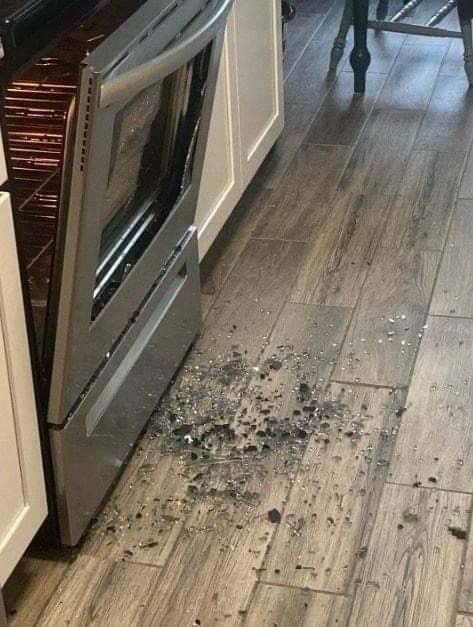
Similarly, Michelle Wheat’s oven door exploded. Just as Truesdale’s oven, Wheat’s oven wasn’t on at the time of the explosion.
Glass scattered all over the kitchen, and luckily, none of her four children was injured. The Consumer Product Safety Commission has received approximately 450 reports of such incidents since 2019. The ovens in question were from different producers.
The three women encountered difficulties with the manufacturers after the incidents. Truesdale’s oven was under warranty, but still, a Frigidaire technician blamed her for the explosion and forced her to pay for a new door herself. NBC’s intervention led Bosch to replace Cheryl’s oven. Wheat, whose oven was out of warranty, had to pay a technician $100 just to confirm the glass was broken, with the replacement costing another $314.
Frigidaire recommended she buy an extended warranty in case it happened again. Frustrated, Wheat remarked, “This should not have happened. That was the point I was trying to make to them.”
Mark Meshulam of Chicago Window Expert gives an explanation about why these explosions may be taking place. “There are two scenarios of why oven glass can break spontaneously,” he said. “There’s one family of oven glass that is soda lime glass, which is window glass, and it’s heated and cooled rapidly so that it becomes tempered. That’s one type of glass that is used in oven doors. Another type is borosilicate glass. It is more used in laboratory glassware or the old time Pyrex glass, and that one tolerates heat and cold very well. So, the shift to soda lime glass has brought about an increase in these types of breaks because it’s not as tolerant of the thermal cycles that the glass will go through.”
continued on the next page
